Why Did Christine Ford Talk in a Baby Voice
What Christine Blasey Ford remembers all-time almost that night thirty-plus years ago is the laughter.
It came, she said, from Supreme Court nominee Brett Kavanaugh and his friend Marking Estimate — two high school boys who drunkenly locked her into the bedroom of a friend'due south firm where she was sexually assaulted by Kavanaugh.
In testimony Thursday to members of the Senate Judiciary Committee, Ford described it as "uproarious laughter" shared by friends who were "having fun at my expense." The memory of it is "enduring in the hippocampus," she said, channeling her training every bit a research psychologist.
Other aspects of that nighttime are seared in her retentiveness too: the bed on the correct side of the room where the alleged attack occurred; the sound of the boys "pinballing" their fashion down the stairway after Ford had locked herself in the bathroom; the sparsely furnished living room she passed equally she exited the house.
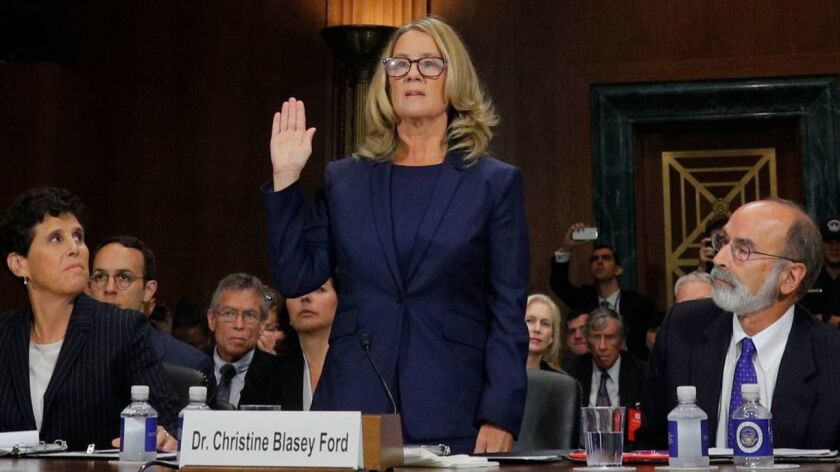
(Jim Bourg/AFP/Getty Images)
Yet there are also meaning gaps in her retentivity, including how she made her way domicile in her traumatized state.
To some members of the committee, those missing memories bandage doubt on all of Ford's allegations. But should they?
In an endeavour to assess her credibility — and by implication, that of Kavanaugh — The Times asked experts in sexual trauma whether Ford's testimony was consistent with the research findings and clinical observations they take made or encountered in their ain work.
Here's what they told us.
Patricia Resick, professor of psychiatry and behavioral sciences, Knuckles University
Who she is: Resick is a leader in the field of sexual trauma. Her inquiry focuses on the lasting effects of traumatic events, peculiarly on women. She has worked with rape victims for more than xl years, and since the 1980s, she has been developing and testing cognitive process therapy every bit a treatment for post-traumatic stress disorder.
What'southward your overall reaction to Christine Blasey Ford'due south testimony?
I am not her therapist and have not met with Ford personally. I am reacting based on my experience with sexual assail survivors.
She said she doesn't remember where it took identify. That rings true considering until you know yous are in danger, there is no reason to think everyday details.
Another matter that rings true is that Ford was clearly emotional when talking about the details of the assail. She says it drastically changed her life, and that she was likewise embarrassed to tell her parents that she was at a business firm drinking with boys.
Practise you lot find it strange that she didn't written report the assault at the time?
She says that she tried to ignore the assault because it made her anxious. Avoidance is a typical response and part of PTSD. She tried to push the effect away and not call back about it.
Were there details that stuck out to you?
The word nearly Ford and her husband going to therapy because she wanted two front doors was a unique moment. Information technology really is corroborating evidence about the impact of the assault on her life. I mean, who else needs two front end doors?
There were several emotional moments during her testimony. What did those say to you?
When Sen. Patrick Leahy (D-Vt.) congratulated her on her bravery, she looked like she was going to cry. The same thing happened when Sen. Dick Durbin (D-Ill.) praised her. When Sen. Richard Blumenthal (D-Conn.) called her testimony "powerful," again, she looked teary. After lunch Sen. Cory Booker (D-N.J.) talked about her sacrifice and bravery. She cried once again.
In all of these cases, she was overwhelmed by the praise she was receiving. Given how hard this has been for her to do, I think she was surprised by the praise. I expect her self-esteem has been and so damaged that she has trouble taking in all the positive statements praising her.
Although at that place were gaps in her retentiveness, in that location were things she recalled with farthermost clarity. Does that signal annihilation?
Her strongest memory of the event was the boys' laughter. She remembers "ii friends having a actually good time with each other."
This speaks to the humiliation and shame that sexual assault victims feel. The shame and humiliation are ofttimes more of import than the fear and speak more to why she stayed silent for so long.
Tracey J. Shors, distinguished professor of behavioral & systems neuroscience at Rutgers University
Who she is: Shors is a neuroscientist who studies memory and its function in overcoming trauma, including sexual violence. She has devised neuroscience-based treatments for PTSD. Her work also examines how stressful events in the past touch behavior and mental health in the time to come, especially in women.
Were there aspects of her testimony that are typical of sexual assault survivors?
In our studies, we prove that women with sexual violence experience oftentimes have many symptoms of anxiety and low and trauma. Clearly, Ford is a poised and intelligent person with sophisticated noesis and insight into her own heed. But you can also tell that this is not easy for her.
Did anything strike you lot about the things Ford remembers from the dark of the alleged set on?
It is interesting to me that Ford says she remembers the context and the layout of the sleeping accommodation, the bathroom where she hid and the stairwell to the room. We only published a written report showing that women with sexual violence history experience vivid memories of the spatial and temporal context of their well-nigh stressful life event.
What else does her account tell y'all about memory?
The brain is always encoding memories, near of which we could not necessarily exist able to call back years or decades afterwards. Otherwise, we would recollect every time and every place we ever parked our car.
Simply we do tend to remember stressful events. We practise this because nosotros need to use those memories to help united states of america survive now and in the futurity. Memories are not in that location merely for reminiscing — they are vital for our survival.
It is also important to realize that the people at the party who were not assaulted or stressed by the event are non every bit probable to remember it. For her, it was a memorable event; for them, it may take just been another time hanging out with few friends hanging at a firm. This applies to the people downstairs but perhaps even for the two boys, specially if they were intoxicated.
Sherry Hamby director of the Life Paths Appalachian Enquiry Center
Who she is: Hamby is a licensed clinical psychologist who has studied violence for more than than 20 years. She helps conduct the National Survey of Children's Exposure to Violence for the U.S. Justice Department. She is as well a enquiry professor of psychology at the University of the South.
In watching this testimony, what resonated for you lot and why?
There were many powerful moments in her testimony, but one that volition stay with me is the fashion, with quavering voice, she described them laughing at her while they were violating her consent. It fits a textbook definition of callousness and objectification.
What do y'all make of the gaps in Ford'due south memory?
Humans don't record events the style that cameras practice. Nigh days we might commit few events to long-term retentivity.
Traumatic memories are different. Our brains are being flooded with chemicals such equally cortisol and norepinephrine that can "sear" events in the manner that Ford described.
We call back dangerous and traumatic events better than other events considering information technology has survival value to recollect them. However, she didn't know beforehand that an assault was going to happen, and so there's no reason to recollect that the earlier events of the day — or even what happened once she had gotten away — would be seared in her retention the way the assail itself was.

(Saul Loeb/AFP/Getty Images)
I have seen a few commentators limited surprise that she could remember details such as having his hand held over her rima oris but non remember the date or the fourth dimension. That is truly ridiculous. Victims are in survival mode during these events. Dates and times are irrelevant constructs when you are fighting for your life.
These factors are likewise the reason why no i else at the party would think it in any item. It was only "normal fourth dimension" to them — no norepinephrine, no cortisol, no danger. This whole event may have been pretty routine for Kavanaugh in a lot of ways, and it may not take been seared in his memory in the way it was in hers.
What about the fact that she remembers the laughter so conspicuously?
The manner she said that the laughter stuck in her listen makes sense. Shaming and humiliation can be simply as damaging as physical assault, and linger long by when bruises and broken bones are healed.
Did you detect her account believable?
She gave 1 of the almost credible accounts I have ever heard from a victim.
The "victim" label is very stigmatizing and associated with stereotypes of passivity and weakness. Ford departed from those stereotypes in important ways. She is an accomplished psychologist, professor and researcher, and I was glad to run into those accomplishments presented at the beginning of the hearing. Not only that, but you could likewise come across her expertise throughout her comments. She was very brave and a role model for all survivors.
Despite her strength, you tin can see the lingering furnishings of her victimization — how information technology has affected her for years, and how, even more than xxx years afterward, it is difficult to talk about.
Any other reactions?
I would likewise say one more thing regarding this retentivity issue. If the reports about Kavanaugh'due south all-encompassing binge-drinking are truthful, then that would raise questions about his power to assert what he did and did not exercise while he was drinking. That could also explain why he might not have specific memories of these events.
Kevin Swartout, associate professor of psychology at Georgia State University
Who he is: Swartout is an expert on the social attitudes and behaviors that contribute to sexual violence, specially against women. Among other things, he studies how booze, drugs, peers and social attitudes can fuel ambitious behavior. One of his specialties is understanding how young men — those a year or two older than Kavanaugh was at the time of the declared assault — negotiate the transition to college.
How do y'all assess the credibility of the claims made past these two witnesses?
Get-go of all, let me caution that it is impossible for me to determine how apparent the accusations are confronting Kavanaugh. All I can do is speak to the lucifer between the details that were presented during the hearing and what nosotros know nigh sexual violence perpetrators from the inquiry literature.
Having stated that, there were several moments from Kavanaugh'southward testimony that especially caught my attention.
He demonstrated a great bargain of hostility during the hearing, especially toward some of the female person senators on the committee. He had a contentious exchange with Sen. Dianne Feinstein (D-Calif.) at the offset, where he cut her off mid-sentence numerous times. There was also the exchange with Sen. Amy Klobuchar (D-Minn), which he later apologized for, where he seemingly tried to flip the ability differential by turning the question back on her.

(Win McNamee/AFP/Getty Images)
The results of hundreds of studies to this bespeak propose that levels of hostility toward women, which includes a drive to exert ability over women, are positively related with levels of sexual violence.
Practise attitudes like that, and their ability to predict behavior, remain pretty stable over a person'southward lifetime?
Across several studies, I take found consistent evidence for a grouping of young men who perpetrate the type of sexual violence described in these allegations, simply but at a relatively immature age — about 14 to 20 years old. These men and then stop perpetrating birthday either before or shortly subsequently they brainstorm college.
This is part of a more general trend researchers have identified regarding boyish antisocial behavior that disappears in one case an private reaches machismo.
Based on my research, 70% to 75% of young men who perpetrated sexual violence merely practise so during a relatively limited fourth dimension frame. Very few of the men who commit sexual violence are serial offenders, so I was non surprised by the idea that these behaviors were express to boyhood.
These interviews have been edited for length and clarity.
Source: https://www.latimes.com/science/sciencenow/la-sci-sn-ford-testimony-credibility-memory-20180928-story.html
0 Response to "Why Did Christine Ford Talk in a Baby Voice"
Post a Comment